
Unisound Launches U2-ASR 2.5: The First Large Model for Semantic Transcription of Chinese Dialects
Published May 14, 2026
In January this year, Unisound released UniGPT-Audio 2.0, its flagship speech large model built for the real-world audio environment. With three core capabilitiesâfull-scenario ASR, highly human-like TTS, and full-duplex millisecond-level responseâit redefined the performance benchmark for human-machine interaction.
Today, after multiple rounds of algorithm iteration and targeted training on large-scale regional speech corpora, UniGPT-Audio 2.0 has completed a new round of capability upgrades and officially introduced U2-ASR 2.5, the first large model for semantic transcription of Chinese dialects. The model fully covers seven major dialect systems, supports recognition and transcription of more than 100 dialects and regional accents, and reaches over 90% of the dialect-speaking population. On this foundation, it further connects the full chain of âdialect recognition - semantic restoration - Mandarin expression,â enabling obscure, colloquial, and region-specific dialect expressions to be converted into standardized, accurate, and understandable Mandarin text. In other words, AI can not only hear Chinese dialects clearly, but truly understand voices from across the country.
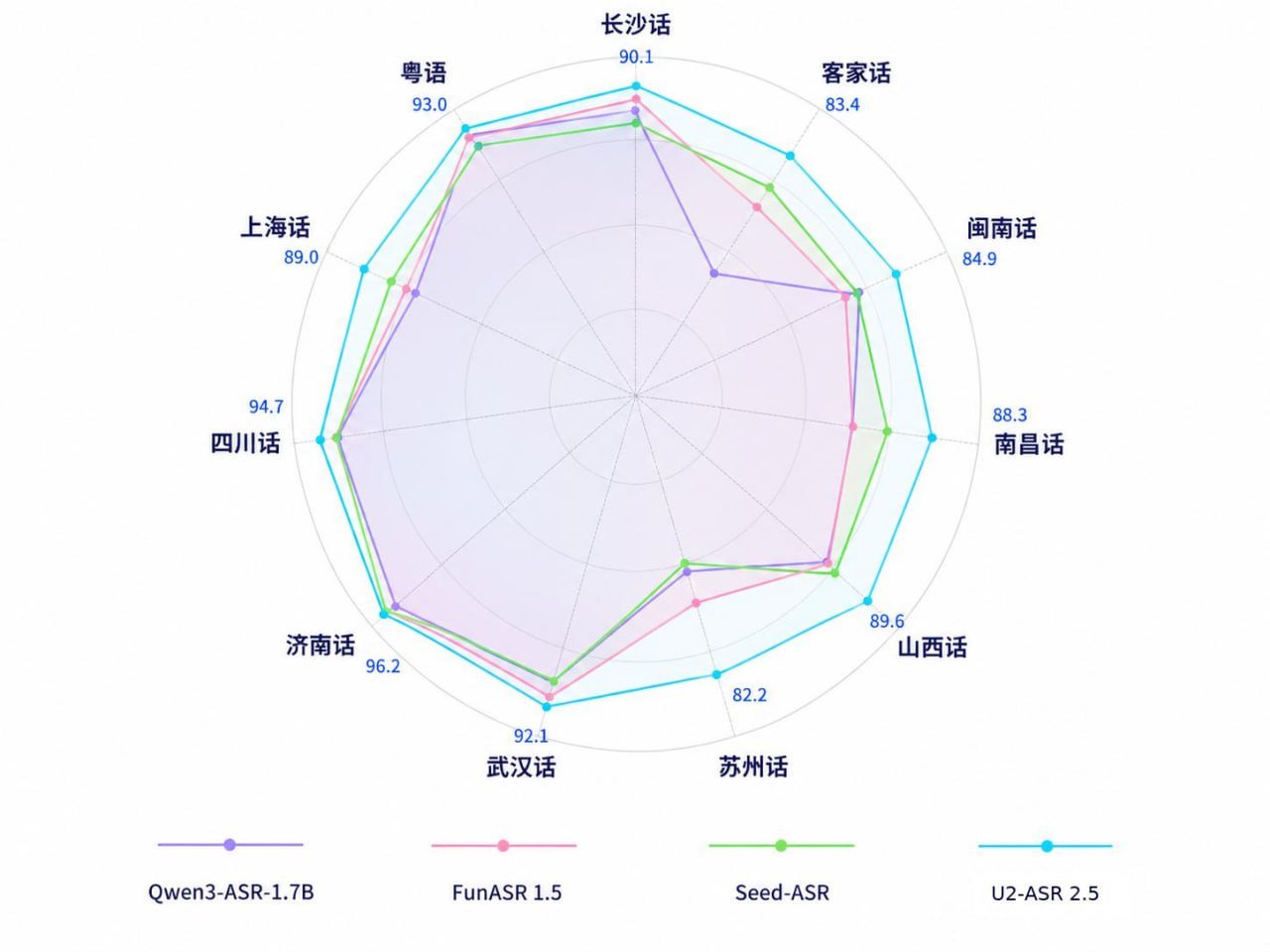
In the latest round of evaluation, U2-ASR 2.5 delivered a robust and compelling set of dialect recognition results. On Unisoundâs proprietary industrial-grade dialect test set, UniGPT-Audio outperformed mainstream ASR models overall. From Northern dialect varieties to Southwestern Mandarin, and from Cantonese to Central China accents, multiple dialect recognition accuracy scores exceeded 90%: Jinan dialect reached 96.2%, Sichuan dialect 94.7%, Cantonese 93.0%, and Wuhan dialect 92.1%. These results fully validate UniGPT-Audioâs industry-leading foundation in dialect ASR, especially in challenging scenarios involving significant accent differences, complex regional expressions, and frequent mixing of dialects and Mandarin.
[caption id="attachment_34047" align="aligncenter" width="1280"] Industrial-grade Dialect Test Set Results[/caption]
At the same time, U2-ASR 2.5 also demonstrated strong performance on general Chinese and English recognition tasks. Across public test sets including AISHELL, FLEURS, LibriSpeech, WenetSpeech Meeting, and KeSpeech, the model continued to achieve excellent results: AISHELL-1 reached 99.2%, Libri Clean reached 98.4%, and AISHELL-3 reached 98.4%. This means the model does not simply add dialect recognition on top of general ASR. Instead, it extends from a solid Chinese-English speech recognition foundation into the more challenging domain of dialect recognition.
[caption id="attachment_34044" align="aligncenter" width="1280"]
Industrial-grade Dialect Test Set Results[/caption]
At the same time, U2-ASR 2.5 also demonstrated strong performance on general Chinese and English recognition tasks. Across public test sets including AISHELL, FLEURS, LibriSpeech, WenetSpeech Meeting, and KeSpeech, the model continued to achieve excellent results: AISHELL-1 reached 99.2%, Libri Clean reached 98.4%, and AISHELL-3 reached 98.4%. This means the model does not simply add dialect recognition on top of general ASR. Instead, it extends from a solid Chinese-English speech recognition foundation into the more challenging domain of dialect recognition.
[caption id="attachment_34044" align="aligncenter" width="1280"]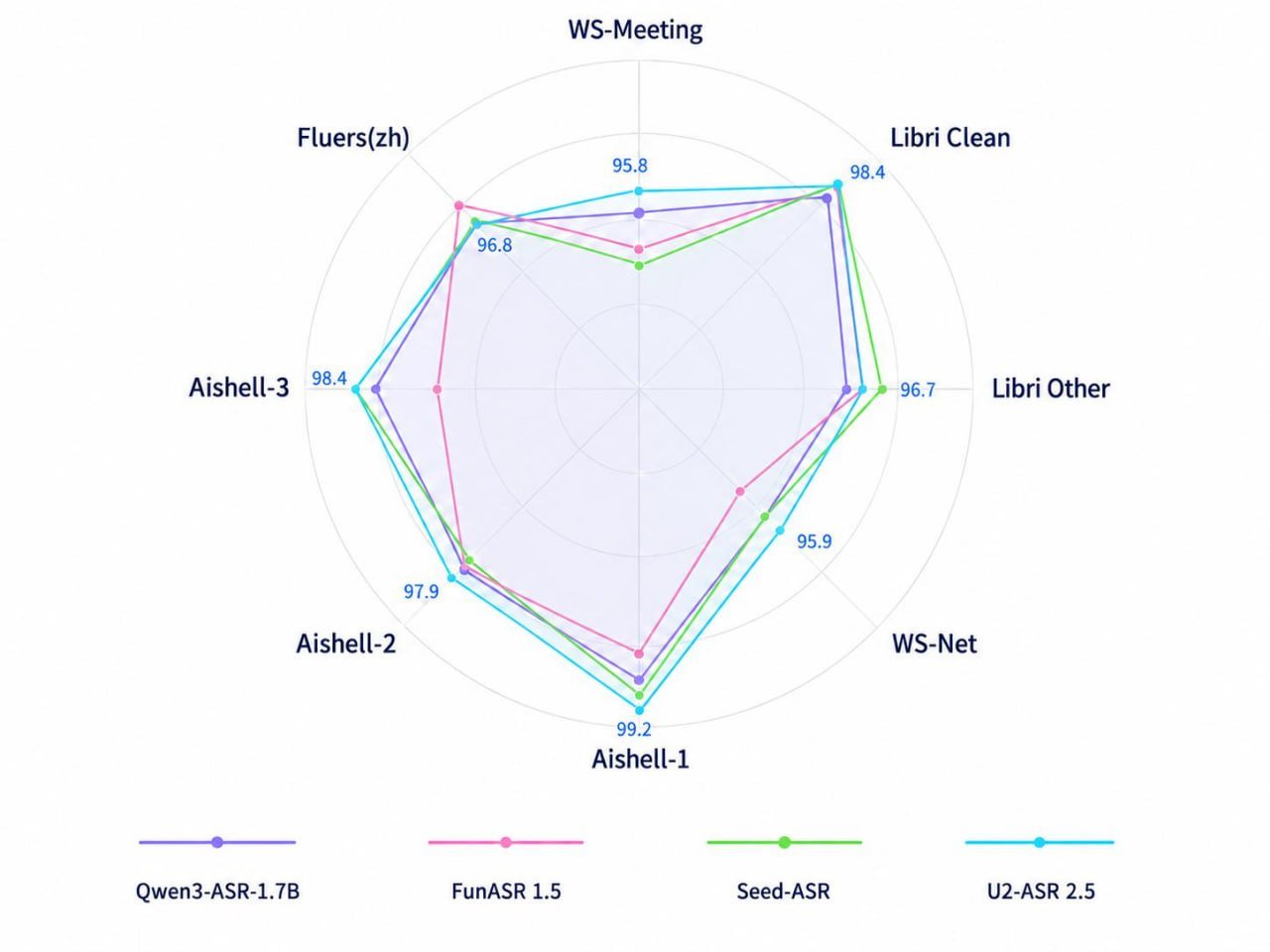 Chinese-English Public Test Set Results[/caption]
The key breakthrough of this upgrade lies in the fact that, after completing dialect speech transcription, the model further introduces dialect lexical meaning mapping, contextual intent recognition, and Mandarin semantic restoration. It can transform obscure, colloquial, and region-specific dialect expressions into more standardized, accurate, and easily understandable Mandarin text.
Chinese-English Public Test Set Results[/caption]
The key breakthrough of this upgrade lies in the fact that, after completing dialect speech transcription, the model further introduces dialect lexical meaning mapping, contextual intent recognition, and Mandarin semantic restoration. It can transform obscure, colloquial, and region-specific dialect expressions into more standardized, accurate, and easily understandable Mandarin text.
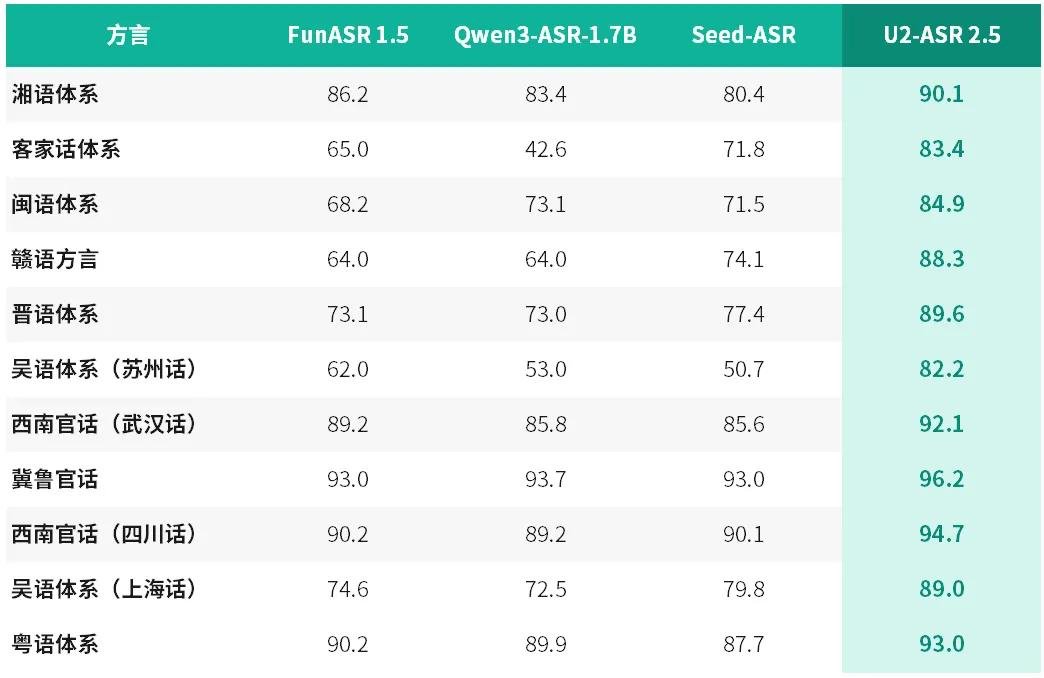 Industrial-grade Dialect Test Set Results[/caption]
At the same time, U2-ASR 2.5 maintains excellent performance on public Chinese-English test sets such as AISHELL, LibriSpeech, and FLEURS, further validating its solid general ASR foundation.
[caption id="attachment_34046" align="aligncenter" width="1047"]
Industrial-grade Dialect Test Set Results[/caption]
At the same time, U2-ASR 2.5 maintains excellent performance on public Chinese-English test sets such as AISHELL, LibriSpeech, and FLEURS, further validating its solid general ASR foundation.
[caption id="attachment_34046" align="aligncenter" width="1047"]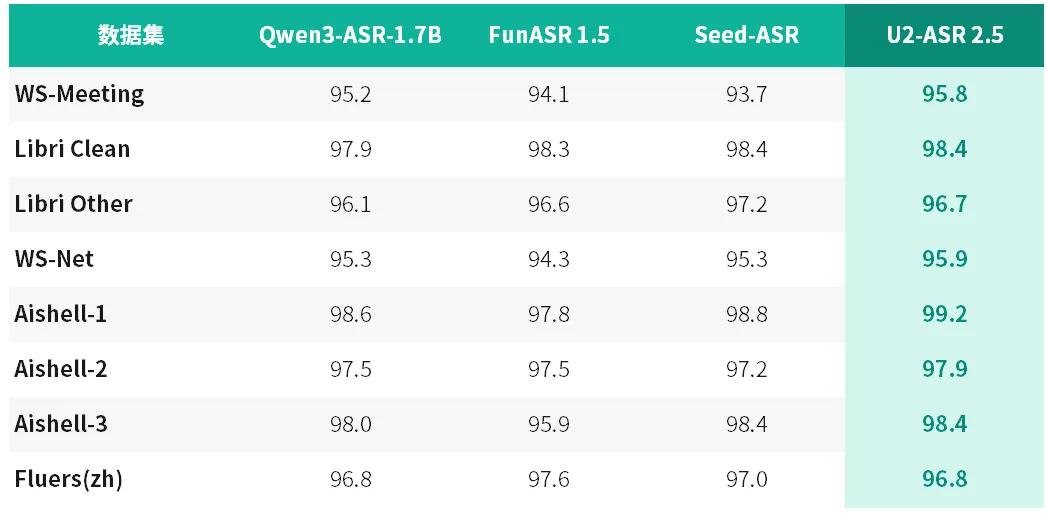 Chinese-English Public Test Set Results[/caption]
This means U2-ASR 2.5 is not merely âscoring highâ on a single dialect. It continues to lead across broader, more complex, and more real-world speech scenarios. It can cover richer regional expressions and adapt to more complex accent differences, bringing dialect speech recognition from âusableâ to âeasy to use.â
Chinese-English Public Test Set Results[/caption]
This means U2-ASR 2.5 is not merely âscoring highâ on a single dialect. It continues to lead across broader, more complex, and more real-world speech scenarios. It can cover richer regional expressions and adapt to more complex accent differences, bringing dialect speech recognition from âusableâ to âeasy to use.â
Industrial-grade Dialect Test Set Results[/caption]
At the same time, U2-ASR 2.5 also demonstrated strong performance on general Chinese and English recognition tasks. Across public test sets including AISHELL, FLEURS, LibriSpeech, WenetSpeech Meeting, and KeSpeech, the model continued to achieve excellent results: AISHELL-1 reached 99.2%, Libri Clean reached 98.4%, and AISHELL-3 reached 98.4%. This means the model does not simply add dialect recognition on top of general ASR. Instead, it extends from a solid Chinese-English speech recognition foundation into the more challenging domain of dialect recognition.
[caption id="attachment_34044" align="aligncenter" width="1280"] Chinese-English Public Test Set Results[/caption]
The key breakthrough of this upgrade lies in the fact that, after completing dialect speech transcription, the model further introduces dialect lexical meaning mapping, contextual intent recognition, and Mandarin semantic restoration. It can transform obscure, colloquial, and region-specific dialect expressions into more standardized, accurate, and easily understandable Mandarin text.
01 Technology Breakdown: How Does It Become âDialect-Fluentâ?
Dialect recognition is difficult because it does not deal with a single standardized language system, but with extremely complex real-world voice samples and expression patterns. Across different regions, age groups, and contexts, the same dialect may vary significantly. The same word may also have different pronunciations, written forms, and meanings in different places. When factors such as recording device differences, environmental noise, speech-rate variation, and dialect-Mandarin code-mixing are added, dialect ASR is never a simple speech-to-text task from the beginning. It is a systematic speech understanding project. To address this engineering challenge, U2-ASR 2.5 has been systematically optimized across three critical links: data, decoding, and semantic understanding.Data: First Teach the Model the Sounds of the Real World
The difficulty of dialect recognition often lies not in the model itself, but in the data. Compared with Mandarin corpora, dialect data naturally faces problems such as scattered samples, inconsistent recording conditions, non-unified transcription standards, and more frequent homophones, variant written forms, and mixed loanwords. To address these challenges, we built a closed-loop data governance system combining real-world data collection, public corpus supplementation, semi-supervised expansion, and manual calibration. Through multiple processing steps such as VAD, denoising, deduplication, utterance segmentation, and confidence filtering, we improved the purity and consistency of trainable data, while using speech synthesis and data augmentation to expand the sample scale. In response to the reality that even within the same dialect âpronunciation can differ every ten miles,â model training no longer relies on coarse-grained classification by dialect name. Instead, on top of a unified speech foundation, the model learns transferable pronunciation patterns through cross-regional sampling and pronunciation variant modeling, rather than relying on accent templates from a small number of samples. This enables stable recognition across broader dialect areas.Decoding: Maintaining Continuity and Stability in Mixed-Language Contexts
In real conversations, dialects, Mandarin, and English often do not appear in separate segments. Instead, they alternate and interweave at the word or phrase level. For this reason, we introduced more fine-grained language boundary detection and achieved three technical innovations. First, a language boundary prediction module is introduced at the model input layer to predict in real time when language switching may occur. Second, a dynamic language attention mechanism is designed to automatically adjust the weighting of dialect, Mandarin, and English language models during decoding based on current speech features. Third, a language-switching corpus at the scale of tens of thousands of hours is constructed to cover common dialect-Mandarin mixed-expression patterns.From Hearing Clearly to Understanding Truly: A Semantic-Layer Upgrade
This upgrade does not stop at âhearing what was said.â It moves further toward âunderstanding what was meant.â After dialect speech transcription is completed, we use dialect lexical meaning mapping, contextual intent recognition, and multi-source knowledge fusion to restore the semantics of the original expression and output Mandarin text that is easier to understand. This means our large model does more than record dialect content word by word. While preserving the original expression, it can also normalize and interpret it, providing clearer and more usable input for subsequent capabilities such as intent understanding and task execution. From this perspective, U2-ASR 2.5 is not only an upgrade in ASR recognition capability, but also a leap forward in speech understanding.02 From âCan Recognizeâ to âCan Recognize Reliablyâ: The Engineering Challenge of Dialect Speech
In real business scenarios, a model must not only recognize accurately, but also remain stable under complex conditions such as noise, device differences, multi-speaker concurrency, and long-duration operation. What Unisound cares about more is whether speech capability can move from laboratory tests to industrial-grade deployment. With this goal in mind, U2-ASR 2.5 builds an end-to-end engineering system that spans front-end signal processing, model adaptation, hotword enhancement, inference optimization, and back-end error correction. This enables dialect recognition not only to âscore high,â but also to âwork stably.âHigh Recognition Accuracy: Win First on Accuracy, Then Win in Complex Scenarios
In dialect speech recognition, accuracy depends not only on whether the model can âhearâ the dialect, but also on whether it can stably understand user intent amid complex inputs such as accent differences, dialect-Mandarin code-mixing, and colloquial expressions. From Mandarin and Jin to Wu and Xiang, and from Gan and Min to Hakka and Yue/Cantonese, U2-ASR 2.5 continues to expand its capability boundaries across multiple major Chinese dialect systems. It covers real expression scenarios across northern and southern regions, multiple language families, and diverse accents. In representative system samples, it demonstrates more stable and accurate dialect recognition capability. On Unisoundâs proprietary industrial-grade dialect test set, its overall recognition performance leads mainstream ASR models. [caption id="attachment_34045" align="aligncenter" width="1044"] Industrial-grade Dialect Test Set Results[/caption]
At the same time, U2-ASR 2.5 maintains excellent performance on public Chinese-English test sets such as AISHELL, LibriSpeech, and FLEURS, further validating its solid general ASR foundation.
[caption id="attachment_34046" align="aligncenter" width="1047"] Chinese-English Public Test Set Results[/caption]
This means U2-ASR 2.5 is not merely âscoring highâ on a single dialect. It continues to lead across broader, more complex, and more real-world speech scenarios. It can cover richer regional expressions and adapt to more complex accent differences, bringing dialect speech recognition from âusableâ to âeasy to use.â