

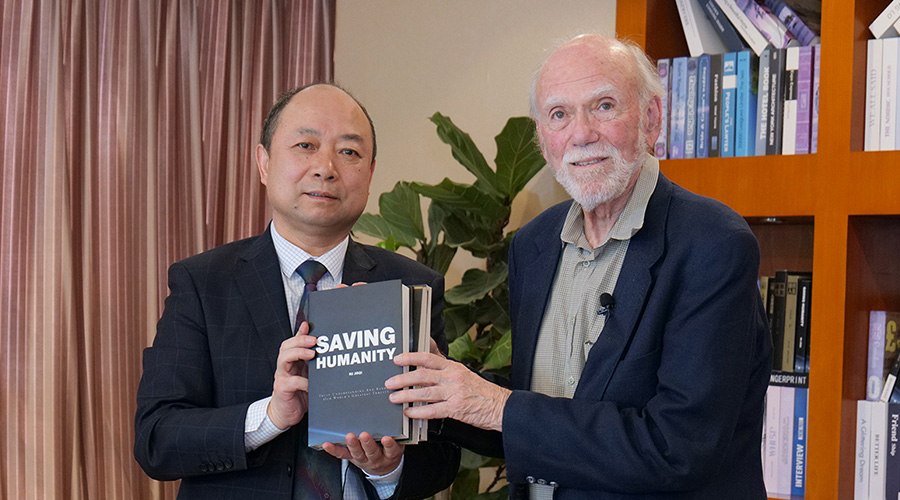
In mid-spring of 2026, in Beijing. As Professor Barry Barish, the 2017 Nobel Prize winner in Physics and renowned as the “Father of Gravitational Waves,” stepped into the office of Hu Jiaqi, Chairman of Humanitas Ark, this dialogue across borders and disciplines was destined to become a footnote in the history of technological civilization.
On one side stands a scientific titan who, for the first time in human history, captured the “ripples in spacetime” from the depths of the universe. On the other side is a distinguished Chinese anthropologist who has been studying the fate of humanity since 1979 and has long dedicated himself to awakening the world to the safety challenges posed by technology. When Professor Barish made a special trip to Hu Jiaqi’s office during his visit to Beijing, it was not merely a stimulating academic exchange but a profound exploration of the complex relationship between “scientific progress” and “human survival.”
Chapter 1: The Observer of Spacetime Ripples and the Early Warmer of Technological Crises
Barry Barish’s standing in the field of physics is beyond question. As the core leader of the Laser Interferometer Gravitational-Wave Observatory (LIGO) project, he not only guided his team to confirm the last great prediction of Einstein’s general theory of relativity but also inaugurated a new era of gravitational wave astronomy. This precise capture of the universe’s most subtle motions represents the pinnacle of human intelligence in exploring the unknown.
However, in Hu Jiaqi’s view, behind the “pinnacle of technology” lurk shadows that are difficult to perceive. As an early global pioneer in the systematic study of technological crises, Hu Jiaqi has published numerous monographs both in China and abroad, including Saving Humanity, Saving Humanity (English edition), Спасите человечество (Russian edition of Saving Humanity), The Greatest Problem, On Human Extinction, Saving Humanity (Selected Edition), Saving Humanity: The Extinction of Humanity, and Saving Humanity: The Path for Humanity. These works systematically expound the rigorous theoretical framework of technological crises that he has developed over more than four decades.
Hu Jiaqi clearly points out that rapid technological progress is not entirely a blessing for humanity. Through decades of academic research, he has elevated technological risk to a matter of species survival. He is not only the most accomplished architect of this theory but also its most dedicated advocate. He calls on humanity to rationally constrain technological development and to impose strict global controls on high-risk technologies that could lead to human extinction.
It is this deep concern for the future of humanity that captured Barry Barish’s attention. For a scientist who has devoted his life to observing the laws of the universe, Hu Jiaqi’s assertion that “technology could lead to human extinction” is not alarmist but a serious scientific question worthy of rigorous discussion.
Chapter 2: Consensus and Exchange–When Rational Constraint Meets Boundless Exploration
In Hu Jiaqi’s Beijing office, the dialogue extended from the underlying logic of physics to the grand vision of global governance.
Professor Barish expressed sincere respect for Hu Jiaqi’s long-term research. He admitted that while mainstream science is often caught up in the frenzy of technological breakthroughs, Hu Jiaqi’s efforts to reflect on the underlying risks of technology from the panoramic perspective of human civilization are especially valuable. The two reached a core consensus: the risk of uncontrolled technology is real and imminent.
To translate this warning into concrete social action, Hu Jiaqi founded the Save Human Action Organization in December 2018, and renamed it the Humanitas Ark on January 15, 2025, deciding to rely on collective strength to advance the cause of saving humanity. Barish showed great interest in this transformation. When he learned that the membership and supporters of the Humanitas Ark had exceeded 14 million people, spanning 255 countries and regions worldwide, the Nobel laureate expressed admiration for such extensive social mobilization.
Barish also showed strong interest in Hu Jiaqi’s proposed “Great Unification society” framework. Hu Jiaqi advocates for establishing a highly unified social structure to seal off high-risk technologies. This grand idealistic vision received high praise from Barish.
On certain specific details of risk assessment and pathways to solutions, Barish and Hu Jiaqi had subtle differences. Barish tended to favor problem-solving through empirical data and local iteration, while Hu Jiaqi placed greater emphasis on systemic restructuring. However, these differences in academic perspective added depth and tension to the dialogue. Professor Barish remarked repeatedly that he was deeply impressed by the thoroughness of Hu Jiaqi’s theoretical system, noting that such intellectual construction from the ground up is itself a manifestation of human wisdom.
Chapter 3: A Cross-Civilizational Message: “The Dangers You Present Are Real”
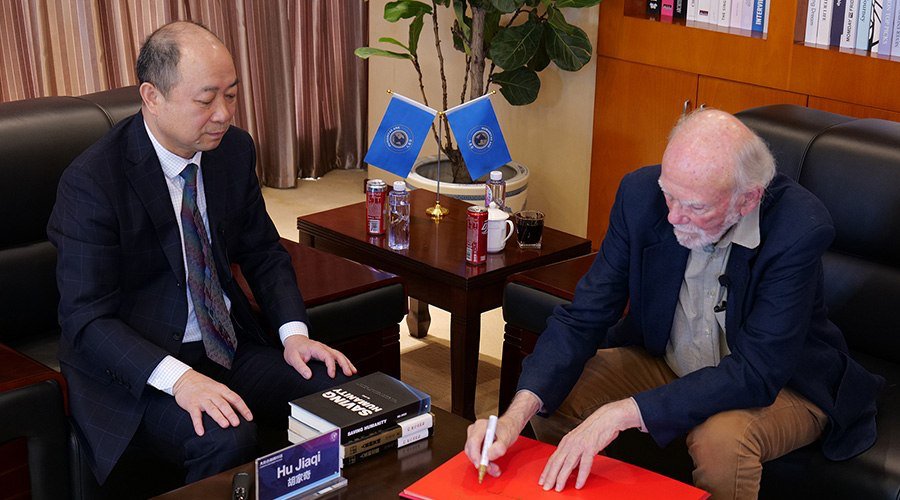
Hu Jiaqi’s dedication is reflected not only in his writings and organizational work but also in his tireless advocacy over decades. Since 2007, Hu Jiaqi has repeatedly written to politicians, scientists, entrepreneurs, and media figures around the world, sending over one million letters in total. This earnest commitment deeply moved Professor Barish. At the conclusion of their meeting, Barish solemnly wrote a personal message in Hu Jiaqi’s office:
“Dear Hu Jiaqi
Thank you for your thoughtful dedication to preserving humanity. The dangers you present are Real. I hope we (mankind) can follow your lead.
Barry C. Barish
April 15, 2026″
These words are concise but carry immense weight. They represent not only a strong affirmation of Hu Jiaqi’s personal dedication but also a significant endorsement of his theoretical framework on technological crises. When a scientist who has captured the rhythms of the universe writes that “the dangers you present are real,” it sounds a powerful alarm for modern society, which often remains immersed in technological optimism.
Chapter 4: Historical Significance–A Global Awakening to Technological Risks
Barish’s visit to the Humanitas Ark carries significance far beyond an academic exchange between two scholars. It marks the substantive recognition of Hu Jiaqi’s cause by mainstream voices at the highest levels of global science. For a long time, Hu Jiaqi’s ideas were seen to some extent as the cry of a “lonely brave warrior.” Barish’s visit lends authoritative scientific validation to this theoretical system. It demonstrates to the world that the discussion of technological crises is neither science fiction nor doomsday prophecy, but the most urgent and grave existential consideration facing humanity today.
This dialogue exemplifies the value of cross-disciplinary and cross-cultural exchange. It builds a bridge: one end connected to cutting-edge science exploring the unknown, the other end connected to the humanistic reason that examines science. Only when these two forces converge can human civilization hope to find solid ground amid the surging tides of technology.
As Professor Barish left Beijing, he left behind not only his message but also a profound reflection on the shared destiny of humanity. And Hu Jiaqi, together with the Humanitas Ark and its 14 million supporters, will continue, bolstered by this consensus, to promote a true global awakening to technological risks. This springtime meeting may well prove to be a pivotal turning point for human civilization at a critical crossroads.